Press Release · FutureMain
FutureMain Sets Its Sights on Nasdaq, Bringing Decades of Industrial Expertise Into the AI Era
Distributed by ScoopByte · Originally issued via PR Newswire
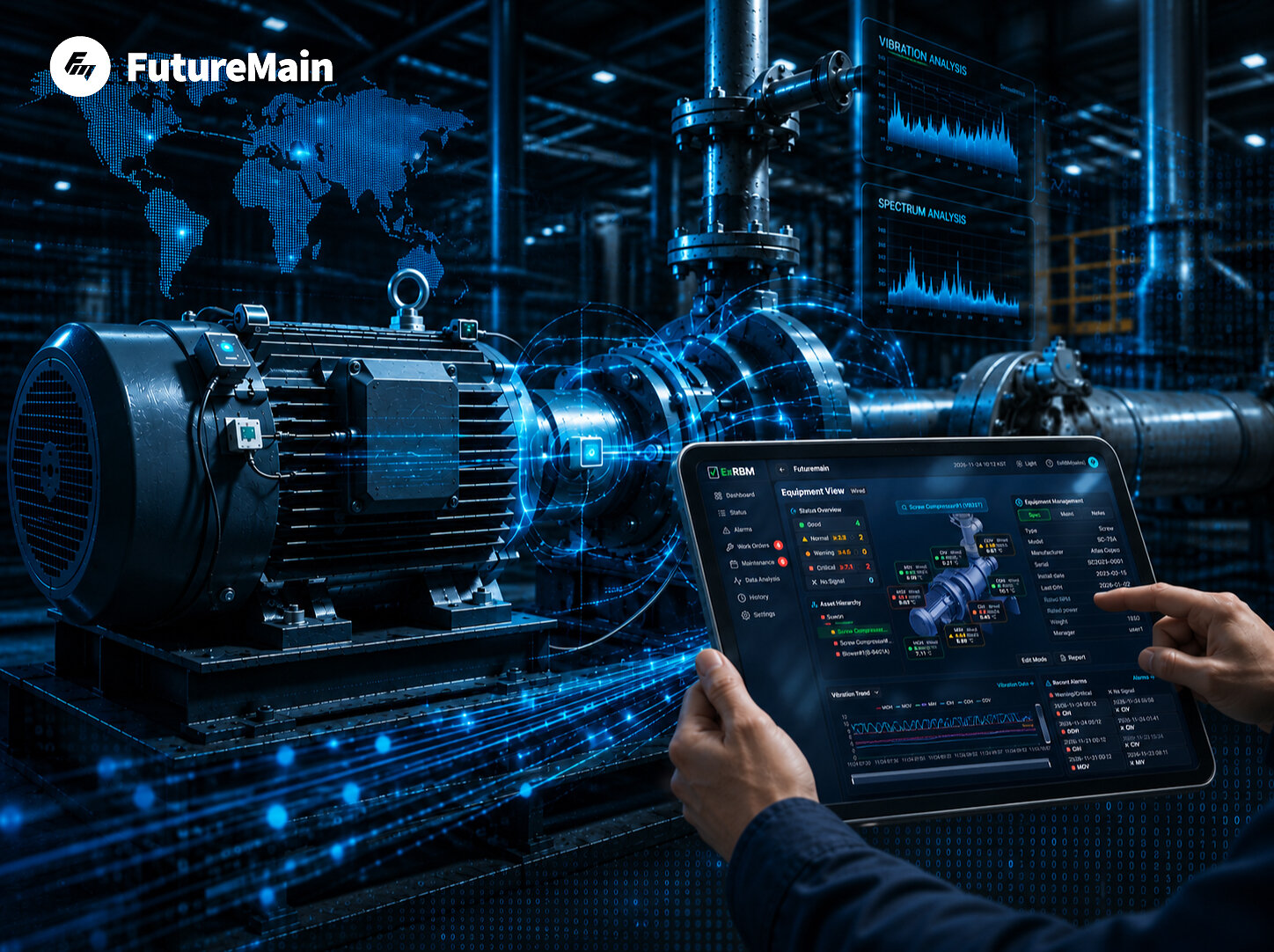
The South Korean industrial AI company combines 38 years of engineering expertise with explainable artificial intelligence, targeting the next generation of intelligent manufacturing.
SUWON, South Korea, Nov. 26, 2026 — FutureMain, a South Korean industrial artificial intelligence company specializing in machinery diagnostics and predictive and prescriptive maintenance, is pursuing a Nasdaq listing as part of its strategy to expand into global manufacturing markets.
On September 11, 2026, FutureMain announced that it had entered into a definitive business combination agreement with ChampionsGate Acquisition Corp., a Nasdaq-listed special purpose acquisition company (SPAC).
Upon completion of the proposed transaction, the combined company is expected to be listed on Nasdaq. The parties anticipate closing the transaction in 2027, subject to regulatory and shareholder approvals and other customary closing conditions.
For FutureMain, the proposed listing represents more than an opportunity to raise its international profile. It is a strategic step toward building the scale, operational capacity and global service infrastructure required to serve major industrial customers.
Deploying new technologies across large manufacturing facilities and mission-critical production systems requires more than technical performance. Global manufacturers also demand long-term business continuity, dependable delivery capabilities and confidence in their technology partners.
By pursuing access to the U.S. capital markets, FutureMain aims to strengthen its international business foundation and accelerate the adoption of its industrial AI technologies.
The ambition is substantial for a company that began with just three people and had approximately 24 employees in early 2026.
Yet the company's vision is rooted in a problem that manufacturers around the world have faced for generations: understanding why machines fail — and preventing those failures before they disrupt operations.
Before Machines Fail, They Send Signals
When a major manufacturing facility unexpectedly shuts down, the consequences can extend far beyond the factory floor.
Automotive production lines, pharmaceutical plants, power generation facilities and shipyards all depend on complex machinery operating reliably, often around the clock.
And before many mechanical failures occur, equipment begins to exhibit subtle changes.
A vibration too faint for the human ear to detect. A temperature variation that is difficult to observe directly. An unusual pattern hidden within operational data.
For decades, experienced maintenance engineers have relied on specialized knowledge and practical experience to interpret these signals.
But what if artificial intelligence could learn to apply the diagnostic expertise accumulated by engineers over generations?
What if industrial equipment could be monitored not simply to detect abnormal conditions, but to identify emerging risks, explain their underlying causes and recommend appropriate maintenance actions?
That is the future FutureMain is working to create.
Turning 38 Years of Engineering Knowledge Into Industrial AI
The global artificial intelligence industry is advancing rapidly, with companies competing to develop increasingly capable models and applications.
Yet applying AI effectively in real industrial environments remains a fundamentally different challenge.
A factory cannot be fully understood through information learned from the internet alone.
Similar vibration patterns may indicate entirely different mechanical problems depending on equipment design, operating conditions and the physical mechanisms involved.
For plant operators, an alarm indicating that something is abnormal is rarely sufficient to justify stopping a critical production line.
What matters is understanding not only what is wrong, but why it is happening and what should be done next.
FutureMain developed its flagship ExRBM platform to address precisely this challenge.
Founded in 2014, the company has incorporated 38 years of accumulated machinery diagnostic engineering expertise from power plants, industrial facilities and manufacturing environments into its AI-based technologies.
ExRBM combines expert knowledge of mechanical failure mechanisms with machine learning, deep learning and actual equipment data.
Rather than relying solely on statistical anomaly detection, the platform is designed to identify specific failure mechanisms, explain the evidence behind its assessments and recommend appropriate responses.
According to company disclosures, ExRBM can automatically identify more than 85 machinery failure mechanisms, including bearing damage and shaft misalignment.
In 100 tests conducted by the Korea Testing Laboratory (KTL), the technology recorded a reported automatic diagnostic accuracy of 98.3% under the specified test conditions.
FutureMain also reports 25 patents and international recognition, including a gold medal at the International Exhibition of Inventions Geneva.
The company believes its most important advantage, however, cannot be measured by the speed at which an algorithm is developed.
It lies in the depth of engineering knowledge embedded within that algorithm.
Decades of experience analyzing normal equipment behavior, abnormal operating conditions and mechanical failures have produced a specialized body of knowledge that is difficult to replicate through software development alone.
By transforming this expertise into AI-driven diagnostic capabilities, FutureMain aims to make advanced industrial knowledge more accessible, scalable and actionable.
Proven Across Industries, From Battery Manufacturing to Shipbuilding
Industrial AI must ultimately demonstrate its value where it matters most: in operating manufacturing facilities.
FutureMain's technologies have been deployed across more than 10 industrial sectors, including battery manufacturing, pharmaceuticals and biotechnology, power generation, energy, shipbuilding and defense.
Its customer references include LG Energy Solution, Hanwha Ocean and Handok.
According to the company's 2026 investor presentation, ExRBM recorded 25 deployments over the preceding three years, while FutureMain's total customer base exceeded 48 companies.
Several customer relationships have also progressed beyond initial deployments.
At Handok's Eumseong pharmaceutical manufacturing facility, applications have expanded from equipment predictive maintenance into the integration of production-process data and quality anomaly detection across granulation, coating and tablet-compression processes.
At Hanwha Ocean, machinery diagnostic applications have been extended to additional equipment following earlier system installations.
FutureMain's collaboration with LG Energy Solution is also moving toward broader applications across domestic and overseas manufacturing operations.
The company is expanding into robotics as well.
In 2026, FutureMain has been carrying out a large-scale predictive maintenance implementation project involving welding robots and traversing equipment at HD Hyundai Construction Equipment's Ulsan facility.
These developments reflect the company's transition from solving individual machinery problems toward building an industrial AI platform applicable across different equipment types, production processes and manufacturing sectors.
International expansion is another area of focus.
FutureMain reports that it has completed a proof-of-concept evaluation at a Saudi Aramco facility and is extending its business network across the Middle East, Southeast Asia and Japan.
From its origins in Suwon, South Korea, the company is positioning its industrial AI technology for a broader role in global manufacturing.
ExRBM 2.0: Moving From Monitoring to Explainable Intelligence
In November 2026, FutureMain introduced ExRBM 2.0 at an AIoT technology presentation held at COEX in Seoul.
The next-generation platform represents an evolution from conventional equipment monitoring toward AI-assisted diagnosis and maintenance decision-making.
Traditional monitoring systems typically generate alerts when vibration, temperature or other operating parameters exceed predefined thresholds.
ExRBM 2.0 takes a more advanced approach.
By analyzing collected equipment data, the platform is designed to identify potential faults, explain their underlying causes and recommend appropriate maintenance actions.
A central feature is explainable artificial intelligence, or XAI, which allows users to examine the reasoning and evidence supporting an AI-generated diagnosis.
This distinction is particularly important in industrial environments.
When a critical machine is at risk of failure, engineers cannot always act on an unexplained warning.
They need to understand the nature of the suspected defect, the relevant frequency characteristics, the location or timing of abnormal signals and the maintenance actions that may be required.
By providing this context, ExRBM 2.0 aims to support more informed and confident decision-making.
FutureMain has also presented capabilities connecting machinery diagnostics with remaining useful life (RUL) estimation, maintenance work orders and automated diagnostic reporting.
RUL estimation is applicable depending on equipment characteristics and the availability and quality of relevant data.
In addition, the company has introduced the concept of an AI assistant based on a small language model (sLLM), enabling users to interact with machinery information and maintenance records through natural-language queries.
Instead of manually navigating multiple diagnostic screens, an engineer could ask:
"What problem has been detected in this machine?"
"Which component should be inspected first?"
"How should we determine the appropriate maintenance timing?"
The objective is not to replace experienced engineers.
It is to preserve, transfer and extend their specialized knowledge, allowing more industrial professionals to benefit from advanced diagnostic expertise.
Beyond Predictive Maintenance: AI That Understands the Entire Factory
FutureMain's long-term strategy extends well beyond machinery diagnostics.
The company is pursuing a manufacturing-focused vertical AI platform that connects equipment health, production processes, quality management and robotics.
Modern manufacturing facilities generate enormous volumes of data, including machinery vibration, electrical current, temperature, process pressure, equipment load and quality inspection results.
When these data sources are analyzed independently, manufacturers may identify isolated problems without understanding their broader operational relationships.
FutureMain sees an opportunity to connect them.
By integrating equipment-condition data with production and quality information, industrial AI could move beyond detecting individual machinery faults to understanding more complex interactions across manufacturing operations.
The company's longer-term vision includes industrial AI agents capable of interpreting factory-wide conditions, analyzing operational risks and recommending appropriate responses.
Robotics represents another potential growth area.
As industrial robots become more widely deployed, technologies capable of diagnosing their mechanical condition and identifying emerging failure patterns may become increasingly important.
FutureMain is conducting research into technologies that learn normal and abnormal robotic operating patterns, on-device AI and Physical AI applications tailored to industrial environments.
Some of these initiatives remain in research and development.
Nevertheless, the company's strategic direction is clear: to build on its established machinery diagnostic expertise and expand toward AI systems that understand manufacturing processes, product quality and the increasingly interconnected relationship between humans and robots.
A Vision Built on Real-World Expertise
The ultimate purpose of industrial AI is not defined solely by the complexity of its algorithms or the number of patents behind it.
Its value can be found in more fundamental outcomes.
Helping prevent unexpected machinery shutdowns.
Supporting safer working environments.
Enabling more informed decisions where experienced specialists are in short supply.
And helping manufacturers produce the goods that society depends on with greater reliability.
While much of the world's attention is focused on the latest advances in generative AI, FutureMain believes the physical signals produced by industrial machinery remain an essential source of intelligence.
Behind those signals are decades of engineering knowledge and practical experience.
Shine Lee, FutureMain's Chief Operating Officer and a founding member who joined the company when it consisted of just three people, believes that this foundation will become increasingly important as the AI market matures.
"Today, countless AI-powered products and services are being created, only to disappear as quickly as they emerge," Lee said. "AI services without deep technological foundations can easily be replaced by similar offerings. In an increasingly crowded AI market, what truly matters is building AI on technologies and expertise that cannot be easily replicated."
Lee emphasized the importance of connecting artificial intelligence with the physical realities of manufacturing.
"Understanding real industrial equipment requires going directly into factories, examining machinery, installing sensors and collecting reliable physical data," she said. "The ability to acquire that data and transform it into meaningful intelligence for AI-driven decision-making is what FutureMain does best. It is also the foundation of our long-term competitive advantage."
Looking ahead, Lee described a vision that extends beyond traditional engineering AI.
"Our ambition is to evolve into a Hyperconnected Autonomous AI company — one where data from across the factory is seamlessly interconnected, enabling manufacturing operations to pursue optimal efficiency and continuous self-improvement."
This vision reflects FutureMain's belief that the next generation of industrial AI will be defined not simply by more powerful models, but by deeper integration with the physical world.
Building the Next Generation of Industrial Intelligence
FutureMain's journey, supported by 38 years of accumulated engineering expertise and a team of approximately 24 employees in early 2026, is moving beyond South Korea toward new opportunities in global manufacturing.
The proposed Nasdaq listing could represent an important milestone in that journey.
Yet the company's larger ambition is not defined by a stock market valuation.
It is rooted in the belief that AI capable of understanding real industrial environments can contribute to safer workplaces, more productive factories and a more resilient manufacturing ecosystem.
Around the world, millions of machines continue to operate inside factories, power plants, shipyards and industrial facilities.
Each generates signals that reveal something about its condition.
FutureMain is working to transform those signals into actionable intelligence — connecting decades of engineering expertise with the capabilities of modern AI.
The future of manufacturing may depend not only on making machines more intelligent, but on giving artificial intelligence a deeper understanding of the physical world.
And for FutureMain, that future is already taking shape on the factory floor.
SOURCE FutureMain