Press Release · Nudge Security
More Than Half of Organizations Using AI Agents Run Them Across Multiple Platforms, Nudge Security Research Finds
Distributed by ScoopByte · Originally issued via PR Newswire
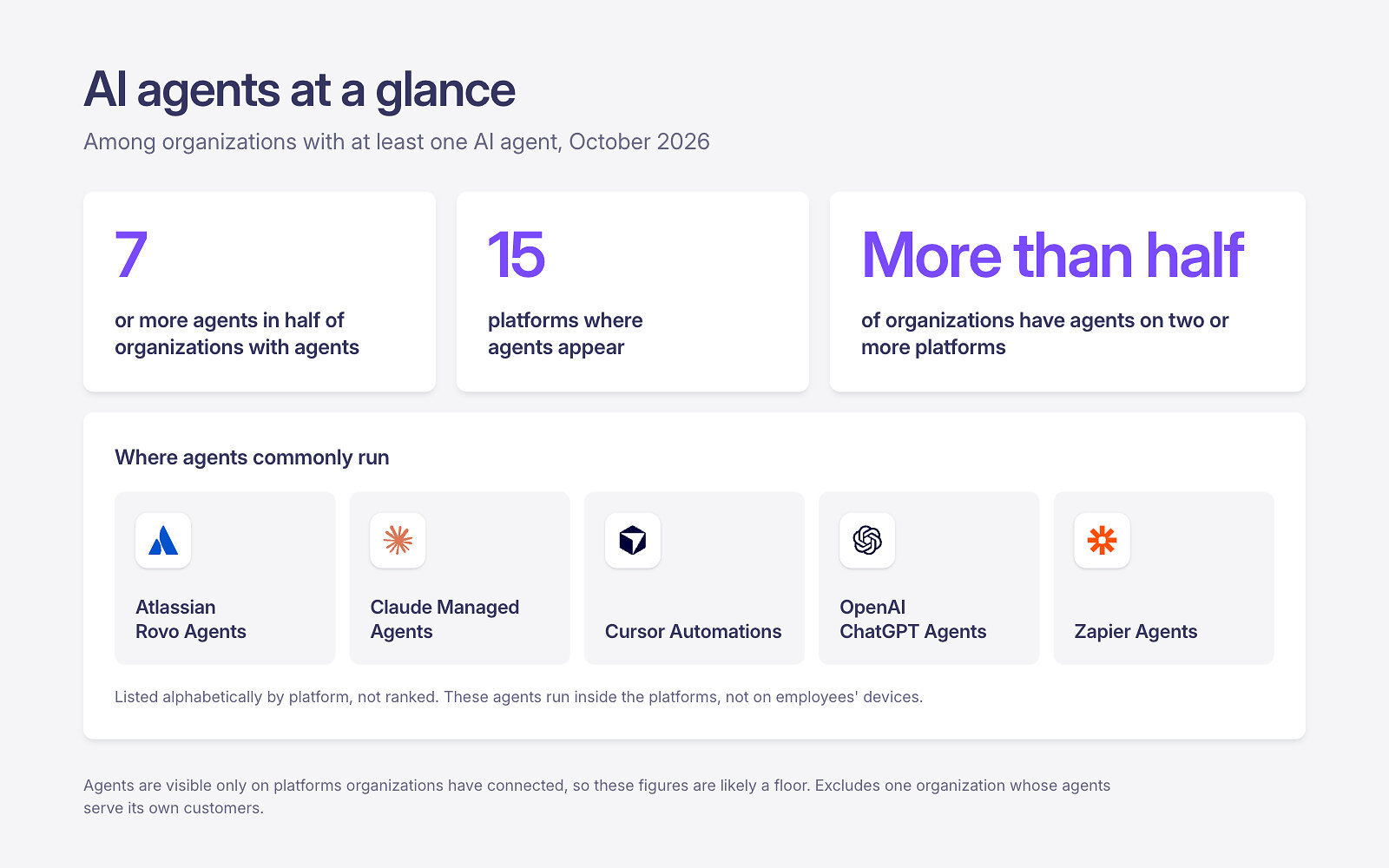
Second edition of "AI Adoption in Practice" report shows AI risk now lives on the Workforce Edge, where employees choose, connect, and use technology, as agents and AI integrations reach company data outside traditional security controls
AUSTIN, Texas, Nov. 17, 2026 — Nudge Security, the leading innovator in SaaS and AI security governance, today announced its research report, AI Adoption in Practice 2026: Beyond the Approved List, which provides insights into what AI adoption in the workforce looks like in practice. Based on anonymized and aggregated telemetry from Nudge Security customer environments, the report found that AI agents are already running inside the business platforms employees use every day, and that AI tools connect directly to company data in ways traditional security controls don't see.
"The platforms your teams use every day are becoming agent platforms, whether or not anyone decided they should be. The project tracker, the CRM, the chat tool: each one now lets an employee build something that acts on their behalf, with their access, continuously. The question for security teams is no longer whether that's allowed. It's whether they know it's happening," says Nudge Security Cofounder and CTO Jaime Blasco. "We expect this to get harder, not easier. Every platform your teams use is adding agent-building features, and each one makes it simpler to hand an agent a person's access. That means the gap between what an organization's identity provider knows about and what's actually acting on its data is going to keep widening."
Key findings include:
- Many agents run on employees' identities. Among organizations using AI agents, half run seven or more, and more than 4 in 10 run more than 10. They're spread across business platforms like project management, CRM, and automation tools. Agents built inside these platforms often act through the employee who created them, with that person's access to company data.
- AI connects directly to the most sensitive systems. 74% of organizations have at least one Anthropic integration and 67% have an OpenAI integration. These reach email, code, chat, and documents, and they move data without passing any inspection point.
- Core AI models are treated like a commodity. At least 91% of organizations have both OpenAI and Anthropic. Anthropic's adoption rose from 77.8% in January to 94.5%.
- AI adoption extends well beyond the big two. Twelve different AI tools now each appear in more than half of organizations, up from five in January. Counting every AI tool in each environment, half of organizations have had 27 or more show up as of October 2026.
- AI in the browser sees what employees see. Among organizations with at least one AI browser extension, 67% have Grammarly and 65% have Claude. Both can read the content of the pages employees open.
- Company data flows into AI as part of everyday work. 18% of observed prompts include pasted content or an uploaded file, compared with 17% in the first report. Prompts are also reaching more AI tools: OpenAI still receives more than half of all observed prompts, but its share fell from 67% to 55% as more prompts go to other tools.
The report is based on anonymized and aggregated telemetry collected across Nudge Security customer environments. Rather than relying on surveys or self-reported usage, it reflects direct observation of AI tools, integrations, browser extensions, agents, and how employees interact with AI. Adoption, integration, and browser extension data is as of September 2026, and agent data is as of October 2026. The dataset includes organizations in Nudge Security's first report, AI Adoption in Practice: What Enterprise Usage Data Reveals About Risk and Governance, as well as customers who have joined since.
What Security Leaders Can Do Now
Visibility alone will not reduce AI risk, so the report recommends focusing on where exposure is actually growing.
- First, inventory agents where they are built in the business platforms teams already use, and identify who created each one and whose access it runs on.
- Second, treat OAuth grants as a first-class risk by reviewing which AI tools employees have connected to, what each grant can read, and revoking any that are no longer needed.
- Third, stop relying on the approved list as the main control and shift attention from which tools are present to what they are connected to.
- Fourth, review AI browser extensions that can read page content and set clear expectations for which are appropriate for sensitive work.
- Fifth and final, bring the workforce into the decision. Employees often know why they connected a tool, so ask, guide, and reserve the strictest response for the decisions that carry the most risk.
Download the full report: https://www.nudgesecurity.com/content/ai-adoption-in-practice-nov-2026.
Media Contact:
Danielle Ostrovsky
Hi-Touch PR
[email protected]
SOURCE Nudge Security
About Nudge Security
Nudge Security is the AI and SaaS security platform for the Workforce Edge. Every day, employees sign up for apps, connect AI tools, and grant access to company data on their own. Together, those decisions create the Workforce Edge: an attack surface security teams own, even when they can't see it. Nudge finds those apps, accounts, and connections from the first signup and prioritizes them by risk, with AI agents taking repetitive review work off the team's plate. Then it goes straight to the employee behind the decision—to ask why, guide the next step, or fix the issue—and steps in directly when the risk is real. Security and IT teams govern the workforce's technology without blocking productivity. Nudge Security was founded in 2021 by Russell Spitler and Jaime Blasco and is backed by Ballistic Ventures, Forgepoint Capital, Cerberus Ventures, and Squadra Ventures.