Press Release · NASA
Thank You for Doing NASA Science!
Distributed by ScoopByte · Originally issued via NASA
It’s Thanksgiving time, and we’re giving thanks to you for doing NASA Science with us! You and NASA’s other volunteers have enabled an incredible banquet of discoveries—by taking data, analyzing data, writing code, writing papers, and even inventing your own science projects. Whether you’re an expert participant or someone who’s just started your science journey, we’re deeply grateful for your help.
Here are a few more messages of gratitude our scientists sent in to share with you.
Chihoko Cullens, principal investigator (PI) of the Space Cloud Watch project, said: “Thank you to Pirjo Koski, Huub Eggen, and Brian Scott! Pirjo posts beautiful Noctilucent Cloud photos and has introduced us to other cloud databases in the Netherlands. Huub goes beyond basic data requested by us and actively discusses his observations providing helpful insights. Brian contributes consistently and has provided us with useful time-lapse videos. All three volunteers have consistently provided much needed data and have contributed their time in developing our Field Guide that now helps new citizen scientists correctly identify and report their observations. We are grateful for their contributions.”
Ryan Scott from the Open Science Data Repository Analysis Working Groups (OSDR AWGs) project said: “A cohort of high school students took NASA’s free Machine Learning for Space Biologycourse and then kept working as citizen science volunteers. Guided by OSDR AWG members who also gave their time freely, they mined open-access retinal data from the International Space Station (ISS) Rodent Research-9 Mission in the NASA Open Science Data Repository and trained a machine learning ensemble that separates oxidative damage from cell death in the eyes of space-flown mice, now published in the scientific journal npj Microgravity: Machine learning ensemble reveals distinct molecular pathways of retinal damage in spaceflown mice. Every citizen science student co-author earned authorship, and many of those listed above started college this fall with a NASA publication already behind them. Thanks to Aditi Adapala, Mushtaq Ali, Naomi Z. Chang, Sophie Cai, Margaret Hitt, Anishka Jain, Matthew Lin, MarcAnthony Paolieri Della Monica, Elior Paley, Rudransh Pathak, Shawnak Samaddar, Shriya Sawant, Zhihan Shi, Rohin Sood, Fabian P. Uribe, Maxwell Volkan, and Jessica Wu, plus OSDR AWG members Anna Lewkowicz, Sunny Narayanan, Daniya Thomas, Ethan Waisberg, Pinar Avci, Joshua Ong, Marshall Tabetah, Richard Barker, Lauren Sanders, and Xiao Wen ‘Vivien’ Mao.”
Kyra Shaw, project coordinator for Snapshot Wisconsin at the Wisconsin Department of Natural Resources, said: “Our team has a Thanksgiving thank-you message for Snapshot volunteer Tim Sparks. Tim has been a dedicated Snapshot Wisconsin volunteer for nearly 10 years. Tim went above and beyond these past two years by helping to pilot test protocols and then joining the full launch for a new initiative, the Snapshot Phenology Project. Joining a select group of volunteers, Tim set up and is maintaining extra equipment to measure snow depth, temperature, and sound recordings at his Snapshot trail camera site. Thank you, Tim, for joining in our events, sending in your favorite photos, and going the extra mile to make the Snapshot Phenology Project a success!”
Benjamin Fernando from the Impact Flash! project said: “Thank you to everyone who’s been sending in images of the Moon! A special thanks to Joerg Tomczak, who helped us with the Artemis II campaign!”
Rachael Mady from the Chesapeake Water Watch project said: “We are so thankful for all of our volunteers! Since 2021, volunteers have been with us every step of the way and have made Chesapeake Water Watch possible. The Chesapeake Bay is the nation’s largest estuary, and we had people all over submitting observations and helping us cross our 6,000 observation milestone this year. While the project may be wrapping up, the impact that our volunteers have on improving the health of the Bay will continue for years to come. Thanks for all that you do!”
Marc Kuchner, from the Backyard Worlds: Planet 9 science team, said: “Thank you to Prateek Singh for creating new tools for astronomy and for helping us lead our Space Apps challenge! Thank you to Bruce Baller and Katharina Doll for sharing their lists of brown dwarf discoveries and for inspiring all of us! Thank you to Frank Kiwy for his latest batch of python tools – shared with everyone – that dig through Pan-STARRS, WISE, SIMBAD, Gaia DR3, CatWISE, and NSC DR2 data! Thank you to Michiharu Hyogo for keeping the new publications coming, Hugo Durantini Luca, Jim Rabe, and Lisa Stiller for helping keep us all connected, Peter Jalowiczor for traveling around the world in the snow, and to Farid Cedeno and Martin Bilsing for teaching others about our project!”
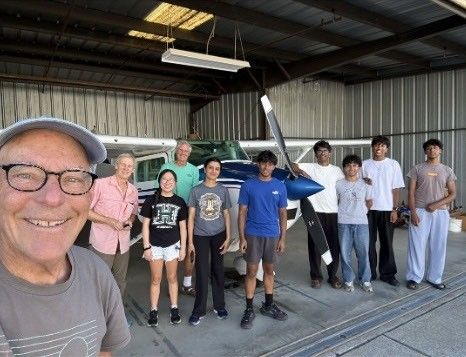
Emma Yates, PI of the Ozone Where We Live (OWWL) project, said: “We have developed an amazing collaboration with Quest Science Center, a non-profit that among many other things supports high school students interested in the Earth’s climate. One of the aspects of Quest is to develop student-run studies by pairing high school students with mentors. OWWL has been working with these students and their Quest mentors to study air quality in the Tri-Valley Region in California (Bay Area into San Joaquin Valley). We designed a mini field campaign over the month of August, with 12 science flights and ground-based sensors at participants’ homes. I know the students (and mentors) would get a kick out of seeing their work highlighted by NASA!”
Everyone can join the fun and make a lasting mark on NASA science. You’ll find all our open opportunities at https://science.nasa.gov/citizen-science/. Happy Thanksgiving!